About This Player
Lloyd Allen pitched in seven seasons as a big league reliever and five of them with the California Angels.
Drafted in the first round of the 1968 draft, Allen looked to have a bright future ahead of him. Allen made his Angels debut in 1969 and, at the age of 19, had the rare distinction of being the youngest player in the Major Leagues on the same team as the oldest player (Hoyt Wilhelm at age 46.) Allen pitched his finest season in 1971 with a 2.49 ERA and 15 saves that season. In 1972, Allen had a 3.48 ERA and 5 saves on an Angels team that reached only 16 saves that season.
From there, Allen's career went downhill. Allen had trouble finding the strike zone and, in five games with the Angels, he recorded a 10.38 ERA. Allen was traded to the Texas Rangers in 1973. He was selected from waivers by Chicago White Sox in 1974. Allen made his final Major League appearance in 1975.
About This Card
An Angel in the outfield, Lloyd Allen is pictured in the outfield at Anaheim Stadium. Allen is also pictured in the outfield in his 1972 Topps cards.
Showing posts with label California Angels. Show all posts
Tuesday, October 16, 2012
Saturday, November 5, 2011
36 - Steve Barber
About This Player
Steve Barber enjoyed 16 seasons in the Major Leagues and two of them with the California Angels. Barber was recognized most for his eight year tenure with the Baltimore Orioles. Barber made his big league debut for the O's in 1960 and, while he had an American League sixth-best 3.22 ERA, he led the league in walks and wild pitches. He soon became the ace of the pitching staff. In 1961, he pitched to a record of 18-12 and tied for the league lead with eight shutouts. In 1963, he became the first pitcher in modern Orioles' history to win 20 games in a season with a 20-13 record, 180 strikeouts and a 2.73 ERA. He was selected as an All-Star in 1963 and 1966; tendonitis kept Barber out of the All-Star Game in 1966 and also kept him out of the Orioles' World Series win against the Los Angeles Dodgers.
On April 30, 1967, Barber pitched 8-2/3 innings against the Tigers before being relieved by Stu Miller to combine for a no-hitter in a 2-1 loss. The Orioles started the ninth inning with a 1-0. Barber walked the first two batters. He then retired the two batters after. He threw a wild pitch that lead the tying run score. After another walk, Barber was pulled. The go-ahead run scored on an error and Stu Miller got the final out.
For more information:
Blogging Baseball: Another No Hit Loss...
Barber was known both for his electric fastball and his wildness. Fellow starting pitcher, Jim Palmer, spoke highly of Barber, saying that, "[Barber] had some elbows problems, but he was a very accomplished pitcher. And he was a good guy." Former teammate and outfielder, Paul Blair described Barber as "the perfect teammate." Barber still ranks 7th all-time among Orioles pitchers with 918 strikeouts.
Barber spent the latter half of his career as a journeyman pitcher plagued by injuries. In the middle of the 1967 season, Barber was traded to the New York Yankees. He later pitched for the Seattle Pilots, Chicago Cubs, Atlanta Braves, California Angels and San Francisco Giants. Barber played his final game in 1974.
Barber passed away on February 4, 2007 from pneumonia at the age of 68.
About This Card
This card features a shot of Steve Barber on his follow-through from the mound. While Barber had been a starting pitcher for the better part of his career, he pitched almost exclusively in relief from 1970 onward.
Steve Barber enjoyed 16 seasons in the Major Leagues and two of them with the California Angels. Barber was recognized most for his eight year tenure with the Baltimore Orioles. Barber made his big league debut for the O's in 1960 and, while he had an American League sixth-best 3.22 ERA, he led the league in walks and wild pitches. He soon became the ace of the pitching staff. In 1961, he pitched to a record of 18-12 and tied for the league lead with eight shutouts. In 1963, he became the first pitcher in modern Orioles' history to win 20 games in a season with a 20-13 record, 180 strikeouts and a 2.73 ERA. He was selected as an All-Star in 1963 and 1966; tendonitis kept Barber out of the All-Star Game in 1966 and also kept him out of the Orioles' World Series win against the Los Angeles Dodgers.
On April 30, 1967, Barber pitched 8-2/3 innings against the Tigers before being relieved by Stu Miller to combine for a no-hitter in a 2-1 loss. The Orioles started the ninth inning with a 1-0. Barber walked the first two batters. He then retired the two batters after. He threw a wild pitch that lead the tying run score. After another walk, Barber was pulled. The go-ahead run scored on an error and Stu Miller got the final out.
For more information:
Blogging Baseball: Another No Hit Loss...
Barber was known both for his electric fastball and his wildness. Fellow starting pitcher, Jim Palmer, spoke highly of Barber, saying that, "[Barber] had some elbows problems, but he was a very accomplished pitcher. And he was a good guy." Former teammate and outfielder, Paul Blair described Barber as "the perfect teammate." Barber still ranks 7th all-time among Orioles pitchers with 918 strikeouts.
Barber spent the latter half of his career as a journeyman pitcher plagued by injuries. In the middle of the 1967 season, Barber was traded to the New York Yankees. He later pitched for the Seattle Pilots, Chicago Cubs, Atlanta Braves, California Angels and San Francisco Giants. Barber played his final game in 1974.
Barber passed away on February 4, 2007 from pneumonia at the age of 68.
About This Card
This card features a shot of Steve Barber on his follow-through from the mound. While Barber had been a starting pitcher for the better part of his career, he pitched almost exclusively in relief from 1970 onward.
Tuesday, September 6, 2011
123 - Sandy Alomar
About This Player
Sandy Alomar played 15 seasons in the Major Leagues and six of those seasons with the California Angels. Alomar made his big league debut in 1964 with the Milwaukee Braves. He had bounced from the Braves to the Mets to the White Sox with whom he established himself as a starting second baseman.
Alomar was traded to the Angels in the middle of the 1969 season with whom he had his greatest success. He played in 648 consecutive games from 1969 through 1973 earning him the nickname "The Iron Pony." Alomar was also selected as an All-Star in 1970. Alomar later played for the Yankees, with whom he would have his only post-season appearance, and finished his career with the Texas.
After his playing career ended, Alomar became a manager in the minor leagues and in his homeland Puerto Rico. He later served as a Major League coach for the San Diego Padres (1986-1990), Chicago Cubs (2000-2002), Colorado Rockies (2003-2004) and New York Mets (2005-2009).
Alomar's two sons, Sandy Jr. and Roberto, both enjoyed lengthy Major League careers. Sandy Jr., a Rookie of the Year and six-time All-Star, played in 20 seasons as a catcher with seven different clubs. Roberto, a 12-time All-Star and ten-time Gold Glove winner, played in 17 seasons as a second baseman with seven different clubs and was inducted into the Hall of Fame this year.
About This Card
During his six seasons with the California Angels, Alomar wore "4" from 1969 through 1971. In the middle of the 1971 season, he switched to "2" (while teammate Tony Conigliaro switched to "4") and wore this number through 1972. In 1973, Alomar switched to "24" and wore that up to his trade to the Yankees in the middle of the 1974 season.
Sandy is pictured in number "2" in this photograph.
Sandy Alomar played 15 seasons in the Major Leagues and six of those seasons with the California Angels. Alomar made his big league debut in 1964 with the Milwaukee Braves. He had bounced from the Braves to the Mets to the White Sox with whom he established himself as a starting second baseman.
Alomar was traded to the Angels in the middle of the 1969 season with whom he had his greatest success. He played in 648 consecutive games from 1969 through 1973 earning him the nickname "The Iron Pony." Alomar was also selected as an All-Star in 1970. Alomar later played for the Yankees, with whom he would have his only post-season appearance, and finished his career with the Texas.
After his playing career ended, Alomar became a manager in the minor leagues and in his homeland Puerto Rico. He later served as a Major League coach for the San Diego Padres (1986-1990), Chicago Cubs (2000-2002), Colorado Rockies (2003-2004) and New York Mets (2005-2009).
Alomar's two sons, Sandy Jr. and Roberto, both enjoyed lengthy Major League careers. Sandy Jr., a Rookie of the Year and six-time All-Star, played in 20 seasons as a catcher with seven different clubs. Roberto, a 12-time All-Star and ten-time Gold Glove winner, played in 17 seasons as a second baseman with seven different clubs and was inducted into the Hall of Fame this year.
"Sandy can run. He'll create excitement. The fans will be looking for him to go every time he's on first. He has the flair of a Lou Johnson. His edge is that he is 10 years younger." - Angels coach Rocky Bridges on Alomar after his trade from the White Sox.
About This Card
During his six seasons with the California Angels, Alomar wore "4" from 1969 through 1971. In the middle of the 1971 season, he switched to "2" (while teammate Tony Conigliaro switched to "4") and wore this number through 1972. In 1973, Alomar switched to "24" and wore that up to his trade to the Yankees in the middle of the 1974 season.
Sandy is pictured in number "2" in this photograph.
Saturday, June 25, 2011
220 - Nolan Ryan
About This Player
Nolan Ryan pitched in 27 seasons, the most from any one player, with four different teams. One of the most prolific players in baseball history, Ryan holds the record for career strikeouts (5,714 K's) and single season strikeouts (383 K's in 1973), as well as career walks (2,795 BB's) and is the all-time leader in no-hitters (seven total and three more than any other pitcher.) Dubbed the "Ryan Express," Ryan had been selected to eight All-Star Games, including a start in 1979. Ryan was also inducted into the Baseball Hall of Fame in 1999 and is the only player to have his number retired by three teams.
Ryan made his Major League debut with the New York Mets in 1966. Ryan earned a regular spot on the Mets' roster, but was used as a spot starter and reliever. Ryan was also a member of the 1969 Mets team that won the World Series and pitched 2-1/3 shutout innings in Game 3 for the save. However, Ryan struggled during his time with the Mets and eventually requested a trade.
The California Angels traded for Ryan prior to the 1972 season. Ryan was given an opportunity to start and he responded with an American League leading 329 strikeouts that year, the first right-handed pitcher to throw more than 300 strikeouts since Bob Feller did in 1946. In 1973, Ryan broke Sandy Koufax's single-season record with 383 strikeouts. He also threw his first two no-hitters that year. Ryan would go on to pitch two more no-hitters and lead the American League four more times during his tenure with the Angels.
Ryan signed as a free agent with the Houston Astros in 1981. That year, Ryan would throw his fifth no-hitter and lead the National League with a 1.69 ERA. By the end of the 1982 season, Ryan and Phillies pitcher, Steve Carlton were both approaching Walter Johnson's all-time strikeout record. (Ryan and Carlton sometimes passed each other in the race.) Ryan would break the record on April 27, 1983 and Carlton would pass Johnson's mark two weeks later. In 1987, Ryan would lead the National League again with a 2.76 ERA and lead for the first-time in the National League in strikeouts with 270 K's. He would lead the NL again the next year with 228 K's.
Ryan joined the Texas Rangers in 1989 threw more than 300 strikeouts for the sixth time to lead the American League and would tally his 5,000 career strikeout (striking out A's outfielder, Rickey Henderson.) In 1990, Ryan threw his sixth no-hitter and earned his 300th win. In 1991, on the day that Rickey Henderson would break Lou Brock's all-time stolen base record, Ryan would throw the seventh no-hitter of his career. Ryan would throw his last pitch on September 22, 1993 at the age of 46.
Ryan continues to remain active in Major League Baseball. Ryan became the president of the Texas Rangers in 2008 and now shares ownership of the Texas Rangers.
About This Card
The back of the card regards Ryan as the "4th greatest strikeout hurler in modern baseball" citing his strikeout total in 1972 and the comparison with Feller, Koufax and Rube Wadell.
Nolan Ryan is one of two players from the 1973 set who appears in his regular-issue Topps card as late as 1994. (Charlie Hough also appeared in the 1994 Topps set.)

Nolan Ryan pitched in 27 seasons, the most from any one player, with four different teams. One of the most prolific players in baseball history, Ryan holds the record for career strikeouts (5,714 K's) and single season strikeouts (383 K's in 1973), as well as career walks (2,795 BB's) and is the all-time leader in no-hitters (seven total and three more than any other pitcher.) Dubbed the "Ryan Express," Ryan had been selected to eight All-Star Games, including a start in 1979. Ryan was also inducted into the Baseball Hall of Fame in 1999 and is the only player to have his number retired by three teams.
Ryan made his Major League debut with the New York Mets in 1966. Ryan earned a regular spot on the Mets' roster, but was used as a spot starter and reliever. Ryan was also a member of the 1969 Mets team that won the World Series and pitched 2-1/3 shutout innings in Game 3 for the save. However, Ryan struggled during his time with the Mets and eventually requested a trade.
The California Angels traded for Ryan prior to the 1972 season. Ryan was given an opportunity to start and he responded with an American League leading 329 strikeouts that year, the first right-handed pitcher to throw more than 300 strikeouts since Bob Feller did in 1946. In 1973, Ryan broke Sandy Koufax's single-season record with 383 strikeouts. He also threw his first two no-hitters that year. Ryan would go on to pitch two more no-hitters and lead the American League four more times during his tenure with the Angels.
Ryan signed as a free agent with the Houston Astros in 1981. That year, Ryan would throw his fifth no-hitter and lead the National League with a 1.69 ERA. By the end of the 1982 season, Ryan and Phillies pitcher, Steve Carlton were both approaching Walter Johnson's all-time strikeout record. (Ryan and Carlton sometimes passed each other in the race.) Ryan would break the record on April 27, 1983 and Carlton would pass Johnson's mark two weeks later. In 1987, Ryan would lead the National League again with a 2.76 ERA and lead for the first-time in the National League in strikeouts with 270 K's. He would lead the NL again the next year with 228 K's.
Ryan joined the Texas Rangers in 1989 threw more than 300 strikeouts for the sixth time to lead the American League and would tally his 5,000 career strikeout (striking out A's outfielder, Rickey Henderson.) In 1990, Ryan threw his sixth no-hitter and earned his 300th win. In 1991, on the day that Rickey Henderson would break Lou Brock's all-time stolen base record, Ryan would throw the seventh no-hitter of his career. Ryan would throw his last pitch on September 22, 1993 at the age of 46.
Ryan continues to remain active in Major League Baseball. Ryan became the president of the Texas Rangers in 2008 and now shares ownership of the Texas Rangers.
About This Card
The back of the card regards Ryan as the "4th greatest strikeout hurler in modern baseball" citing his strikeout total in 1972 and the comparison with Feller, Koufax and Rube Wadell.
Nolan Ryan is one of two players from the 1973 set who appears in his regular-issue Topps card as late as 1994. (Charlie Hough also appeared in the 1994 Topps set.)
Monday, June 6, 2011
354 - Billy Parker
About This Player
Billy Parker played very briefly in three seasons with the California Angels. Parker made his Major League debut on September 8, 1971 and hit the game-winning home run. He would play briefly on the big league roster from 1971 through 1973 while spending the majority of those seasons with Triple-A Salt Lake City. Parker was selected by the Yankees as a Rule 5 pick in 1974, but never made it back to the big leagues.
After his professional career in baseball, Parker worked in home construction and later with youth sports programs in Surprise, Arizona. The city of Surprise named its baseball field as The Billy Parker Field in 2002. Parker passed away February 9, 2003.
About This Card
Billy Parker would only have two Topps cards, his rookie card in 1972 and this card.
Billy Parker played very briefly in three seasons with the California Angels. Parker made his Major League debut on September 8, 1971 and hit the game-winning home run. He would play briefly on the big league roster from 1971 through 1973 while spending the majority of those seasons with Triple-A Salt Lake City. Parker was selected by the Yankees as a Rule 5 pick in 1974, but never made it back to the big leagues.
After his professional career in baseball, Parker worked in home construction and later with youth sports programs in Surprise, Arizona. The city of Surprise named its baseball field as The Billy Parker Field in 2002. Parker passed away February 9, 2003.
About This Card
Billy Parker would only have two Topps cards, his rookie card in 1972 and this card.
Wednesday, May 25, 2011
502 - Bobby Valentine
About This Player
Bobby Valentine enjoyed ten seasons as a utility infielder and outfielder for five different clubs. Valentine made his Major League debut in 1969 with the Dodgers; in the season, Valentine had only been brought in as a pinch-runner in five different games. Valentine remained in the big leagues in 1971 and started in five different positions that year.
Valentine was traded to the Angels in 1973, though his season was shortened from a multiple compound leg fracture when his spikes got caught in the chain link fence at Anaheim Stadium while attempting to catch a home run ball hit by Dick Green. Though the injury robbed him of his speed, Valentine returned the following season and played in 117 games and made 414 plate appearances, the second most of his career.
Just before the end of the 1975 season, Valentine was traded to the Padres. On June 15, 1977, Valentine, along with pitcher Paul Siebert, were traded to the Mets for Dave Kingman as part of "Saturday Night Massacre." On that night, Tom Seaver was also traded to the Reds for four players and Mike Phillips was traded for Joel Youngblood. To make room on the roster for the new players, player-manager Joe Torre retired as a player.
Valentine's playing time was limited with the Mets and we was released just before the 1979 season. He signed with the Mariners shortly after and finished his playing career in Seattle.
Valentine might be better known in baseball circles as a Major League manager. Valentine managed the Rangers for eight seasons and managed the Mets for seven seasons, which include a National League Championship in 2000. He has also been successful as a manager in Japan with a Pacific League Championship in 2005 with the Chiba Lotte Marines. Currently, Valentine serves as a color analyst for ESPN.
About This Card
Bobby Valentine played the entire 1972 season with the Dodgers. As such, here is another example of a picture having been airbrush with the stripes on the pants, the red color over the stirrups and the "Dodgers" whited out of the jersey. Still you can see a trace of Dodger blue in the shirt underneath the jersey.
Bobby Valentine enjoyed ten seasons as a utility infielder and outfielder for five different clubs. Valentine made his Major League debut in 1969 with the Dodgers; in the season, Valentine had only been brought in as a pinch-runner in five different games. Valentine remained in the big leagues in 1971 and started in five different positions that year.
Valentine was traded to the Angels in 1973, though his season was shortened from a multiple compound leg fracture when his spikes got caught in the chain link fence at Anaheim Stadium while attempting to catch a home run ball hit by Dick Green. Though the injury robbed him of his speed, Valentine returned the following season and played in 117 games and made 414 plate appearances, the second most of his career.
Just before the end of the 1975 season, Valentine was traded to the Padres. On June 15, 1977, Valentine, along with pitcher Paul Siebert, were traded to the Mets for Dave Kingman as part of "Saturday Night Massacre." On that night, Tom Seaver was also traded to the Reds for four players and Mike Phillips was traded for Joel Youngblood. To make room on the roster for the new players, player-manager Joe Torre retired as a player.
Valentine's playing time was limited with the Mets and we was released just before the 1979 season. He signed with the Mariners shortly after and finished his playing career in Seattle.
Valentine might be better known in baseball circles as a Major League manager. Valentine managed the Rangers for eight seasons and managed the Mets for seven seasons, which include a National League Championship in 2000. He has also been successful as a manager in Japan with a Pacific League Championship in 2005 with the Chiba Lotte Marines. Currently, Valentine serves as a color analyst for ESPN.
About This Card
Bobby Valentine played the entire 1972 season with the Dodgers. As such, here is another example of a picture having been airbrush with the stripes on the pants, the red color over the stirrups and the "Dodgers" whited out of the jersey. Still you can see a trace of Dodger blue in the shirt underneath the jersey.
Saturday, March 12, 2011
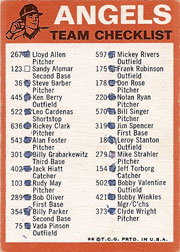
Team Checklist - California Angels
About This Card
This card is the first of the team checklists I will feature on this blog. Although the team checklists are not part of the official 1-660 card numbering, I have decided to include these as part of my set and seek them out.
Wednesday, July 7, 2010
175 - Frank Robinson
About This Player
Frank Robinson enjoyed an illustrious 21 year career in the Major Leagues. While Robinson played in only two seasons with the California Angels, he is better recognized for his playing time with the Cincinnati Reds and the Baltimore Orioles. Robinson won the National League Rookie of the Year Award in 1956 and won two MVP Awards in 1961 with the Reds and 1966 with the Orioles. Between the two teams, Robinson played in five World Series. Robinson was also a 12-time All-Star. In 1975 and 1976, the last two years of his playing career, Robinson served as a player-manager and also became the first African-American manager in Major League history. At the time of his retirement, Robinson ranked fourth on the all-time home run list. Robinson was inducted into the Hall of Fame in 1982.
About This Card
The Frank Robinson card is one of the few cards I bought as an upgrade.
Another interesting note about the photography is the white-out over his jersey. Robinson has played for the Dodgers in 1972, but was traded to the Angels prior to the 1973 season. While the "Dodgers" had been removed from the jersey, he still appears in Dodger blue.
Tuesday, April 13, 2010
597 - Mickey Rivers
About This Player
Mickey Rivers played 15 seasons in the Major Leagues and six of them with the Angels. Known as "Mick the Quick," Rivers only played 30 games in 1973, but established himself as the starting center fielder the following year. Rivers lead the American League in triples in 1974 and 1975 and in stolen bases in 1975. Rivers enjoyed his best seasons with the Yankees after being traded for the 1976 season. With the Yankees, Rivers was a one-time All-Star and played in three World Series. Rivers spent his final seasons with the Rangers.
About This Card
I like the location of this photo with the big "A" in the background. Despite the many changes to Angels Stadium since 1973, the big "A" remains a major landmark in Anaheim today.
Subscribe to:
Posts (Atom)