Showing posts with label Chicago White Sox. Show all posts

Monday, December 30, 2013

194 - Jorge Orta


About This Player
Jorge Orta enjoyed 16 seasons in the Major Leagues and eight of them with the Chicago White Sox.  Orta, born in Mexico, is the son of Pedro Orta, a Cuban-born outfielder who was a baseball superstar during his career in the Mexican League.  The younger Orta also turned down a basketball scholarship at UCLA to start his professional career in the Mexican League.

Orta was signed by the White Sox out of the Mexican League.  He made his Major League debut in 1972, although he spent much of the year with the Double-A Knoxville Sox.  Orta earned the starting second base position in 1973. Orta hit for a batting average of .316 in 1974 and finished second in the American League batting race to the Minnesota Twins' Rod Carew.  Orta earned the first of his two All-Star selections in 1975.

Orta signed as a free agent with the Cleveland Indians in 1980 and became the team's starting right fielder. Orta got six hits in a game on June 15, tying an American League record for most hits in a game.  (In the same game, Toby Harrah drove in seven runs in the 14-5 win over the Minnesota Twins.)  Orta was later selected to his second All-Star game.

For more information:

Orta would be traded later to the Los Angeles Dodgers, New York Mets and Toronto Blue Jays before arriving to the Kansas City Royals.  As a member of the Royals, Orta would become a platoon designated hitter sharing the role with Hal McRae. 

Orta became the center of a controversial blown call in Game 6 of the 1985 World Series.  In the ninth inning, Orta coming in as a pinch hitter, would be called safe on a close play at first base.  Replays showed that the pitcher tagged the base before Orta reached, but the momentum would shift in the Royals' favor and the would win the game and the series against the St. Louis Cardinals.

Orta played his final game with the Royals in 1987.

Orta was inducted into the Mexican Baseball Hall of Fame in 1996.

About This Card
Jorge Orta's 1973 Topps card is a true rookie card without any "Rookie" designation and long before Major League Baseball and Topps created the "Rookie Card" logo. There are a small number of rookie cards in the 1973 set without the "Rookie" designation.  Today, however, you will rarely see a rookie card go by without Topps making any mention of it.


Tuesday, October 25, 2011

561 - Jim Geddes

About This Player
Jim Geddes pitched for the Chicago White Sox in 1972 and 1973.  Geddes pitched a total of 26 innings over the course of 11 games.  Despite the brief call-ups, Geddes spent most of his career in the minor leagues and would retire from baseball in 1975.

About This Card
Jim Geddes makes his only appearance on a Topps card in the 1973 set.

Wednesday, August 17, 2011

42 - Mike Andrews

About This Player
Mike Andrews enjoyed eight seasons in the Major Leagues and three seasons with the Chicago White Sox.  Andrews made his big league debut with the Red Sox in 1966.  The following year, he became the team's starting second baseman and led the American League in sacrifice hits.  He also earned an All-Star selection in 1969.

After five seasons in Boston, Andrews was traded along with Luis Alvarado to Chicago for Luis Aparicio.  Andrews immediately became the White Sox' regular second baseman in 1971.  The following year, Andrews began to decline defensively as he struggled with a bad back.  In 1973, Andrews started the season as the White Sox' first designated hitter.  While he could no longer play regularly in the field, he struggled at the plate and was released in the middle of the season.

July 31, 1973, Andrews was signed as a free agent by the Oakland A's at the request of A's manager and former Red Sox coach, Dick Williams.  Andrews was part of the A's postseason roster for the 1973 World Series.  In Game 2 of the series, Andrews entered the game in the 8th inning as a pinch hitter and took over at second base.  In the 12th inning of that game, Andrews committed two errors which led to a Mets' victory.  A's owner, Charlie Finley, forced Andrews to sign a statement after the game to declare himself disabled and, thus, uneligible for the remainder of the series.  With his teammates and manager, Dick Williams, rallying in his defense, baseball commissioner Bowie Kuhn force Finley to reinstate Andrews.  Andrews pinch hit in the 8th inning of Game 4, which became his final plate appearance in the Major Leagues.

Andrews played one season of baseball in Japan before retiring.

Andrews had served more than 30 years chairman of the Jimmy Fund of the Dana-Farber Cancer Institute.  Andrews has been involved with the Jimmy Fund since his days with the Red Sox and helped raise money for research and treatment for adult and childhood cancers.  Andrews stepped down from his role as chairman in 2009.

About This Card
Mike Andrews is shown in this photograph turning a double play.  Not sure who #33 is sliding into second.  The consensus on Chris Stufflestreet's 1973 Topps Photography blog seems to be the Royals' Bob Oliver at a spring training game.


Tuesday, May 24, 2011

66 - Victory Leaders

About These Players
Steve Carlton played 24 seasons in the Major Leagues and 15 seasons with the Phillies.  In his first season with the Phillies in 1972, Carlton lead the National League with 27 wins for his first time and earned his first Cy Young Award.  Gaylord Perry played 22 seasons in the Major Leagues and 4 seasons with the Indians.  In his first season with the Indians in 1972, Perry lead the American League with 24 wins for his second time and earned his first Cy Young Award.  Wilbur Wood played 17 seasons in the Major Leagues and 12 seasons with the White Sox.  Wood would also lead the American League with 24 wins for his first time and place second in Cy Young voting.

About This Card
Ten pitchers won 20 or more games in 1972.  In contrast, only three pitchers won 20 or more in 2010.

Wednesday, May 11, 2011

105 - Carlos May

About This Player
Carlos May spent ten seasons in the Major Leagues and nine of them with the Chicago White Sox.  May made his big league debut in 1968.  He came third in American League Rookie of the Year voting in 1969 despite missing a good part of his season from an injury, blowing off part of his thumb, in the Marine Reserves.  The injury threatened to end his career, but May was back by Opening Day the following year and started right where he left off.

May describes his experience in the book, What It Means To Be A White Sox:

"For my service, I had to go in one weekend a month, then there was a two-week summer camp. That year, I was at Camp Pendleton. It was August 11 and we were out on the range. The night before, everybody had been drinking beer. We had some hot Budweiser and I'll never forget it. I couldn't sleep, because they had tarantulas running around there. There were spiders and there was no way I was going to sleep, so I stayed up all night. The next morning, we had a six-round volley, which means six mortars all fire at the same time. I was the assistant ammo guy, so I was loading. The guys up on top of the hill had been drinking the night before and they didn't spot my round and didn't say if it hit. We had to go back and the order came down to clean the guns. As the assistant gunner, it was my job to clean them. I had a big, long iron rod with oil and swabbing rags on it to clean the barrel. My round was still in there and hadn't gone all the way down so when I got the swab, I forced it in there and my round pushed down to the firing pin and went off. I think it was the rod shot back up that took off part of my thumb. I was lucky, though. God was with me.I thought about baseball and I didn't know if I would ever play again. They told me if an infection set in, they might have to take my whole thumb off. God was with me and they didn't have to. I kept my thumb and I rehabbed all I could out there. They did a great job for me. I must have had four or five operations, but I came back and played the next year. It was a humbling experience."

"When I got to home plate my first game back, the people gave me a standing ovation and I cried at home plate. It was awesome. It was a thrill just to be back in the big leagues. I think I got a hit that day, but the big thing was to be back. I wasn't sure I'd ever play again, but it worked out. I was honored to be Comeback Player of the Year and I earned it. They didn't give me anything. I hit .285 and had a pretty good year." - Carlos May from What It Means To Be A White Sox by Bob Vorland

During his tenure with the White Sox, May was selected to the All-Star Game in 1969 and 1972.  While the majority of his time was spent in left field, May would spend 1973 as the starting first baseman for the only time in his career; he would move back to left field after the White Sox acquired Dick Allen.

May would finally see postseason action in 1976 after he was traded to the Yankees in mid-season.  May was traded again in mid-season the following year to the Angels with whom he played his final Major League game.

May's brother, Lee May, played in the Major Leagues from 1965 through 1982.

About This Card
I would have liked to have seen a picture of Carlos May from the back on this card or any other Topps card.  May has the distinction of being the only MLB player to wear his birthday on his jersey: MAY 17.

Tuesday, March 8, 2011

648 - Tom Egan

About This Player
Tom Egan played ten seasons at the Major League level.  Egan began his career with in California and played six season as the Angels' backup catcher until he was traded to the White Sox after the 1970 season.  Egan played two season in Chicago as the White Sox's backup catcher. 

After a horrid 1972 season in which he batted .191, Egan was sent to the minors and spent the entire 1973 season with the Iowa Oaks of the American Association.  Egan was selected by the Angels in the Rule 5 draft prior to the 1974 season and remained on the big league roster for the next two seasons.

On September 28, 1974, Egan caught Nolan Ryan's third no-hit game.

About This Card
The White Sox have gone through a lot of uniform changes throughout their history, probably more so than any other Major League Baseball team.  However, it always puzzled me why, from 1971 through 1975, the White Sox wore red.  The color always makes me think of another Major League Baseball team on the east coast.

Thursday, June 10, 2010

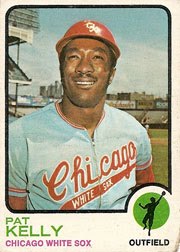
261 - Pat Kelly

About This Player
Pat Kelly enjoyed 15 seasons in the Major Leagues and six of them with the Chicago White Sox.  Kelly made his Major League debut with the Minnesota Twins in 1967.  Kelly was selected by the Kansas City Royals for the 1969 expansion draft and established himself as a starting right fielder.  Kelly was later traded to the White Sox in 1971 with whom he enjoyed his best seasons.  His time in Chicago also led to his selection for the All-Star Game in 1973.  He would later spend time with the Orioles and Indians.

After his retirement from baseball, Kelly became an ordained minister.  Kelly passed away October 2, 2005 from a heart attack.

About This Card
Pat Kelly poses at Yankee Stadium in the White Sox away blues.

Thursday, April 1, 2010

356 - Chuck Tanner MGR


About This Manager
Chuck Tanner spent 19 seasons as a manager in Major League Baseball.  Six of his seasons as manager were spent with the White Sox.  In 1972, Tanner led the Chicago to a second place finish.  He led them to a fifth place finish in 1973.  Tanner is probably best remembered for his time with the Pirates which includes a World Series championship in 1979.

Tanner also spent eight seasons as an left fielder with the Braves, Cubs, Indians and Angels from 1955 through 1962.

About This Card
I like that the manager cards in 1973 also feature the coaches.  Throughout the history of Topps baseball, manager cards have been a regular issue, but including coaches has been on and off.  Personally, I would like to see manager/coaches card in new sets, such as we had seen in 2008 Topps Heritage.

It is also amazing to see coaches on these manager cards who have also had significant careers as players, such as Johnny Sain, the former Braves and Yankees pitcher who was a three-time All-Star and four-time 20-game winner.